HRI Study
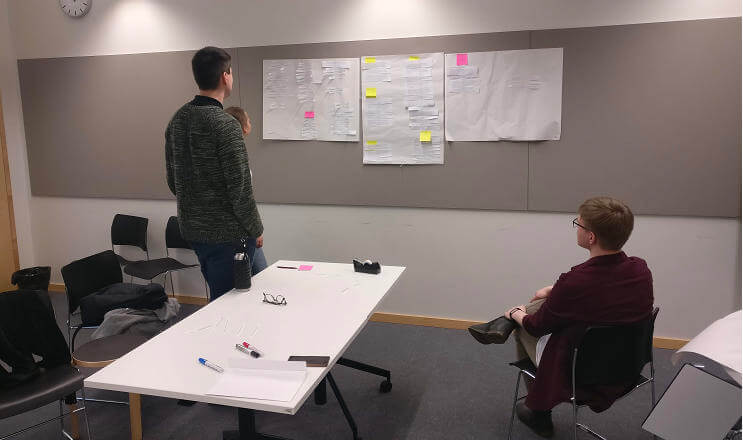
Observation, teacher interviews, and theatrical prototyping shaped a clearer behavior model for a teaching-assistant robot around classroom rituals.
Master's thesis
A grounded theory study on what interaction techniques actually work when the user is wearing gloves, working in noise, and can't afford to be confused by the interface.

Industrial field maintenance is physically demanding. Technicians work in noise, confined spaces, hot and dusty environments, wearing PPE that limits their dexterity. Both hands are usually occupied. The job doesn't pause while they figure out an interface.
XR technology was entering industrial use quickly — maintenance, assembly, training, remote assistance — but most interaction research assumed office conditions. Gloves break touchscreens. Noise drowns out audio feedback. Broad mid-air gestures near machinery are a safety risk. The standard assumptions about how people interact with digital interfaces mostly don't transfer.
The thesis asked: what do the designers and developers who have actually shipped industrial XR know about this? What decisions have they made, and why?
A grounded theory approach — the theory emerges from the data rather than testing a predetermined hypothesis. Six experienced Finnish industrial XR professionals were interviewed: four lead UX designers, a research director, and a software development engineer. All had substantial field experience and had shipped or closely observed industrial XR in the field.
Interview material was transcribed, translated, open coded, and progressively grouped into subcategories, concepts, and categories using constant comparison. A supplementary literature review followed, guided by the grounded theory rather than preceding it.


Speech is the most mature hands-free technology and the easiest for users to accept. Familiar from personal devices, straightforward to implement, and functional even in noisy environments with the right microphone setup. Every participant described it as the most viable primary input channel. The bar is high though: "Good voice control is such that the user does not have to remember anything."
Mid-air gestures have real potential but come with reliability and safety concerns. Optical capture fails in poor lighting. Broad arm movements near running machinery are a hazard. Gloves break most current implementations. The threshold the interviews kept returning to: reliable as a touchscreen, or don't implement it at all. Direct manipulation gestures — pointing at an object to select it — outperform symbolic gestures that require the user to memorize a vocabulary.
Gaze is useful as a side-channel or implicit signal — directing system attention, confirming focus — but not as a primary selection mechanism. The precision demands are too high and the fatigue too significant for sustained use. Every participant agreed that multimodal input is required: no single modality covers all situations, users, or environments.
Unencumbered perception is the single most important factor. The interface has to stay out of the way of the user's awareness of their physical environment — a technician who is focused on a display instead of the machine they're servicing is a safety problem, not a UX problem.
PPE compatibility is non-negotiable. Gloves, helmets, hearing protection — the device has to work with all of them. That alone rules out most touchscreen-first design assumptions and pushes heavily toward voice and touchless freehand as the baseline.
Display readability matters more than immersiveness. A monocular pass-through display the technician can actually read beats a binocular HMD with a narrow FOV and poor outdoor brightness. Participants were clear: "It is very important to get the FOV wide enough." Users need to be able to choose the display that works for their job and conditions. For large-scale field deployment, the smartphone on a suitable holder, extended with touchless input, is still more practical than most current HMDs.
Technicians need just-in-time information access — quick help mid-maintenance, not step-by-step guidance for tasks they already know. The interviews were emphatic about this. Industrial XR content often overcorrects toward explaining everything: "Videos of AR maintenance contain an awful amount of great looking 3D animations... 'We know how to open a screw. We do not need help with that.'" The interface should surface what the technician doesn't know, not rehearse what they do.
Reporting is a significant and underappreciated burden. One participant cited 2–4 hours of an 8-hour shift spent on documentation. "If 2-4 hours of an 8-hour workday is spent on reporting, it is a clear indicator that something has failed." XR has real potential to reduce this — in-situ documentation, automatic logging, photo capture — but only if reporting is designed as a first-class use case, not an afterthought.
Wearables are intimidating in ways that go beyond ergonomics. Technicians worry about looking unprofessional in front of clients, about damaging a €1,500 device in a harsh environment, about being visibly different from their colleagues. "Some of the technicians even think that they don't want to be seen using smartphones on the client's location as the client may think ill of them." Technology acceptance is individual and situational. It can be supported, but not mandated.
When it works, it works well. A technician with the right tool, arriving on site prepared and capable: "Maintenance technician feels like they are a hero because they can solve those problems." That's the experience industrial XR is capable of — and the bar to design toward.
The grounded theory produced a central statement of what industrial XR interaction has to be:
A feasible industrial XR solution requires affordable and robust hands-free operation, with a freehand touchless alternative, of a readable display and an opportunity for eyes-free output — all in a usable and safe manner.
In practice: every design decision for an industrial XR interface should be stress-tested against those five constraints simultaneously. A solution that satisfies one while failing another isn't a trade-off — it's a deployment risk.
The grounded theory produced three interaction design principles for industrial XR:
The grounded theory structured 6 expert interviews into concepts, subcategories, and categories through constant comparison coding. The full table from the thesis:
Six participants is a small sample. All were Finnish, which means the findings carry a cultural context that may not generalize to industrial XR adoption elsewhere. COVID moved interviews online, removing any in-person observation. NDA constraints meant participants could only describe work they were already comfortable discussing publicly. The grounded theory is also untested in a production deployment — its value is in structuring what experienced practitioners know, not in predicting what will ship in any specific industrial context. Read it as a design lens, not a guarantee.